Is there a forced 50% win rate? What Valve says
The theory goes like this: after a win streak, the game gives you bad teammates on purpose to keep you at 50%. In 2021 Valve developer Jeff Hill answered this directly [1]. The matchmaker tries to make every game an even match for both teams, and your personal 50% is just a result of that, not the goal. He said the matchmaker does not optimize for retention or engagement and does not look at how much you spend.
So why won’t the theory die? Because it can be done. In 2017 researchers at EA described EOMM, a matchmaking system that picks opponents to stop players from quitting [5]. In their PvP game, the risk of quitting within a week after a losing streak was 5.1%, almost double the 2.6–2.7% in “safe” states. So the idea is not crazy. Valve just says publicly that Dota doesn’t work like that. Nobody outside Valve has seen the matchmaker code, so the honest version is: there is no proof of a forced 50%, and the official position is that it doesn’t exist.
Valve does admit that match quality can be a problem. In 2019 it said high-MMR games had gotten worse and changed the rules: five-stacks only play against five-stacks, and a solo player can face at most one party of two [2].
Where streaks come from: what players say
The most detailed study of how players experience streaks is by Kou and co-authors at CHI 2018 [3]. They went through 773 forum threads about League of Legends, 4,620 coded entries in total. It is not Dota, but the setup is the same: ranked 5v5 matchmaking.
| How players explain a streak | Share |
|---|---|
| Mental state: tilt, fatigue | 45% |
| How matchmaking works | 33% |
| Their own play | 20% |
| Teammates | 12% |
| Luck | 11% |
The most common reaction was negative emotion (57%), and 35% of players quit the game for a while. Streaks hurt both ways: even after a win streak, people expect “the losing to start now”. The second most popular folk strategy was “pick the OP hero” (20%). That makes sense, but it is only half true: a strong hero in general and a strong hero in this draft are not the same thing.
Tilt was measured: it is real, but small
In 2024 a team from Tampere University checked streaks with data instead of feelings: 597,680 matches of top LoL players [4]. Streaks are linked to performance, but only weakly: KDA is a bit lower after losses and a bit higher after wins. The bigger finding: during a losing streak, players switch heroes and roles more often, and sticking to the same hero and role is linked to better results. One more uncomfortable detail: taking a break after a losing streak barely changes anything (correlation r = 0.017).
So “I’m tilted, that’s why I lose” explains less than it seems. Jumping between heroes is a much more measurable problem.
Some games are uneven before the first creep
The matchmaker balances rating, but not the map side and not the picks. You can see it in the numbers:
The map side gives Radiant +6.9 points in pubs [6]. A normal matchup moves the odds by 0–3 points, a hard counter by 6–8 points [7] [8]. Five picks add up: if the enemy countered two of your key heroes and you countered nobody, the game starts with a clear minus. The matchmaker can’t see this, because its job ended before the hero selection screen.
One more detail: the lower the rank, the more the draft decides. A study of 5 million matches found that picks alone predict the winner best at normal skill and worst at very high skill (ROC AUC 0.706 vs 0.660) [9]. The authors explain that strong players know how to play into counters, while at lower ranks people are confident on fewer heroes.
What you can actually control
- The draft. It is the only part of the match where you change the odds before the game starts. You don’t need to win the draft by a mile, just don’t give away free percent.
- Consistency. A small hero pool and your own role are linked to better results [4]. A counter from your pool beats a “perfect” hero you have five games on.
- The long run. +3 points of win rate is about +6 net wins every 100 games. You won’t feel it in one evening, but you will in a month.
- Honest review. Not every loss is your fault. Sometimes the game was 40/60 already at hero selection, and knowing that stops you from breaking what works.
How Outdraft shows it
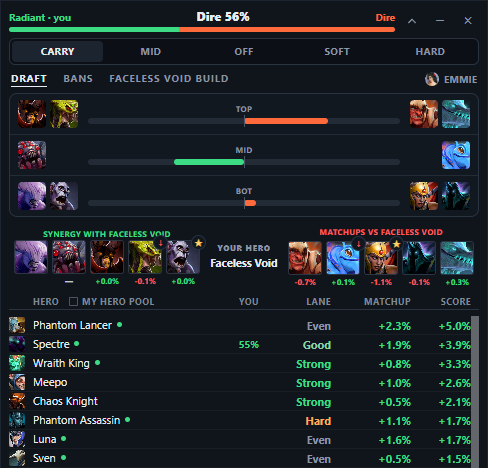
Outdraft shows exactly the part the matchmaker can’t see. During picks, the overlay shows each hero’s impact in % and rates the lanes: Good Even Hard Very hard. The most influential hero gets a ⭐, the weakest gets a 🔻, and the result is shown as a win chance, for example “Dire 64%”.
For your next 10 games, look at the draft chance before the game starts and write down the result. You will quickly see which losses started at 40% and which ones were really on you.